
CYCLE II | The (r)evolution of comic book authors [3/4]



Last Wednesday, June 3, we continued with the project “Visitising comic book illustrators and artists on Wikipedia”, coordinated by Wikisphere and funded by the Women's Institute. The third session of the CYCLE II | The (r)evolution of comic book authors: From Classicism to Modernity, driven by Elisa McCausland y Diego Salgado, He toured the French-Belgian, Italian, German and British comics to show how feminism (and its absence) set the pace for female authorship in each country.
> Listen to the session
We will record all the dissemination sessions of this project that we will organize in several bookstores in Madrid.
Also, you can follow our IVOOX Channel so you don't miss any.
> Summary
Elisa McCausland and Diego Salgado took the tour to Europe in the third session of the second outreach cycle. The starting point of the session was an idea that crosses the whole European landscape: the First Wave Feminism was, above all, an Anglo-Saxon phenomenon, with much less impact on France, Germany or Italy. In a Europe where the dominant culture is literary (and where comics, consequently, are perceived as a minor medium), the irruption of women as authors came later and in a more fragmented way.
In the Franco-Belgian sphere, the modernization of comics came with American strips and, above all, with Tintin, of Hergé, which fixed the format of the album (48-64 pages, landscaped, with print runs of up to 200,000 copies) and the style of the clear line. Women were present from the beginning, especially in children's and girls' magazines, such as the one directed by Jacqueline Rivière (in English), called The Semaine of Suzette (in French), and its comic strip Bécassine (in French), but almost always without authorial recognition. Multifaceted figures such as Manon Lessel (1909-1985), Maggie Salcedo (in French) or Édith Follet (in French) they moved between illustration, advertising and fashion without their work being identified as "work". The real turning point came with the magazine Ah! Nana, arising from the environment of Métal Hurlant, which in the 60s-70s became a space of explicit female authorship, with a feminist perspective and a willingness to appropriate one's own representation. On their pages passed names like Nicole Claveloux (in French), Chantal Montellier (in French), Florence Cestac, Claire Bretécher y Annie Goetzinger, among others.
In Italy, great post-war professionals such as Lina Buffolente y Grazia Nidasio noted for dominating all genders: humor, west, romance, adventures. One of the most unique milestones of the Italian comic is Diabolik, the masked criminal with doses of sadomasochism and violence who became one of the most important characters in the history of the medium, created by the sisters Angela and Luciana Giussani. The creative duo formed by Alessandro Barbucci y Barbara Canepa (both in Italian), creators of W.I.T.C.H. y Sky Doll, illustrates another recurrent tension: the brand model, inherited from Disney, which did not admit personal signature and generated constant frictions with the authorial identity. The Italian equivalent to Ah! Nana was the magazine Strix: giornale di fumetti e altro fatto da donne, feminist and intellectual space where authors such as Cinzia Ghigliano (in French) and Giovanna Maldini (first Italian author to publish an original album). More recently, profiles like Paola Barbato, screenwriter of Dylan Dog, and the editor and theorist Laura Scarpa (in Italian) represent the continuity of that work. The decline of magazines, private television and the advent of manga later transformed the entire Italian publishing landscape.
The German comic book received a shorter mention. Even in the GDR, comics existed, although of a didactic nature and with barely known authors. Anke Feuchtenberger (in German) she was noted as one of the first great German authors, with a postmodern sensibility linked to reunification, in a historically conservative, unpolitical and highly infantilized market.
In the United Kingdom, with its long tradition of popular comics, including funny animals (in English), anthropomorphic animals, and their powerful press culture, Posy Simmonds She was cited as one of the most important authors, with a literary and feminist approach. There was also talk of Marie Duval, which together with Charles Henry Ross, contributed to legitimizing comics among the popular classes at the end of the 19th century.
The whole session was crossed by the same idea: the persistence of brand model above individual authorship, from Hergé to Disney, an industry that has preferred to make its collaborators invisible to maintain a unique signature. This is repeated in creative pairs where the female contribution is silenced, such as Annette Tison (in French), co-creator of the Barbapapa next to Talus Taylor. Genealogical research on these authors is recent in all European contexts and work continues to assist in their visibility.
> Bibliography
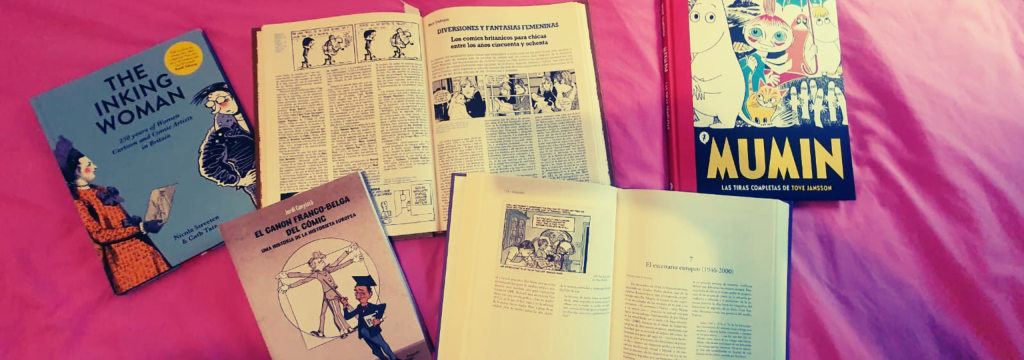
During the session, the following works were mentioned:
- 1905 – The Semaine of Suzette from
- 1976 – Ah! Nana
- 1962 – Diabolik Angela and Luciana Giussani 's
- 2000 – Sky Doll Alessandro Barbucci and Barbara Canepa 's
- 2001 – W.I.T.C.H. Alessandro Barbucci and Barbara Canepa 's
> Collaborate

> Finance

Other Work


 English (UK)