
CYCLE II | The (r)evolution of comic book authors [1/4]

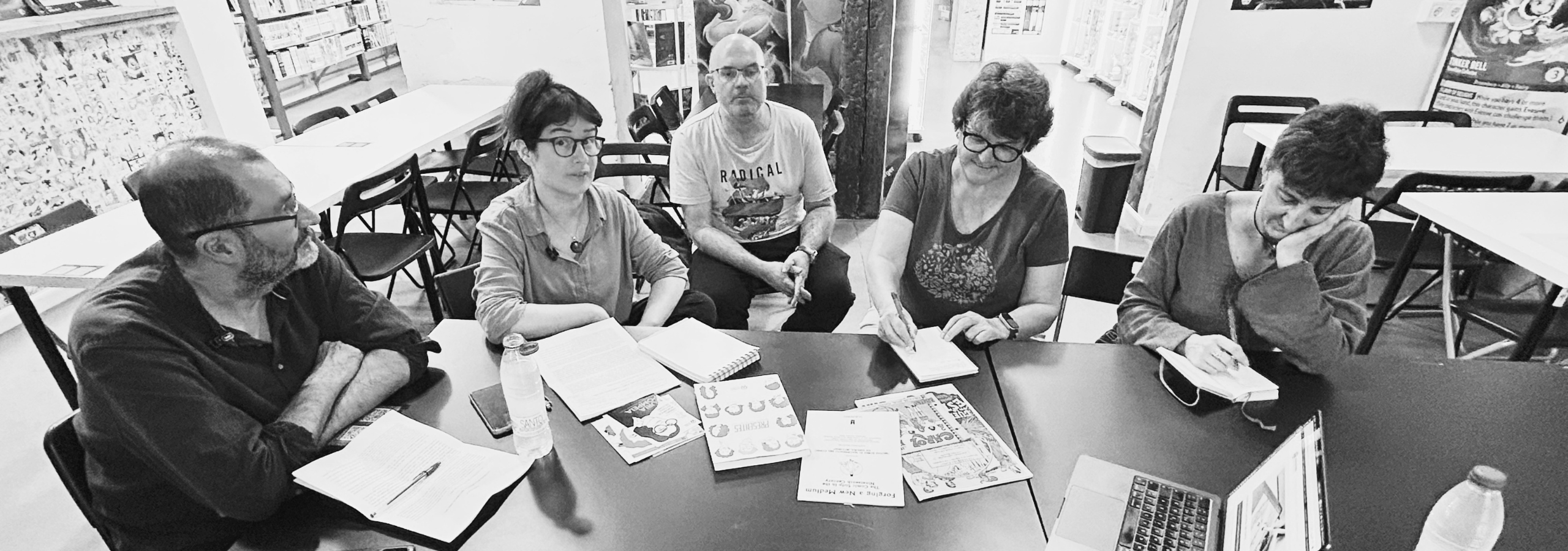


Last Wednesday, May 20th, we continued with the project “Visitising comic book illustrators and artists on Wikipedia”, coordinated by Wikisphere and funded by the Women's Institute. The first session of the CYCLE II | The (r)evolution of comic book authors: From Classicism to Modernity, driven by Elisa McCausland y Diego Salgado, traced a journey through the history of Spanish illustrators and comic book authors from the 19th century to the 60s, recovering essential names that the official story has left in the margins. From the bourgeois pioneers of the illustrated press to figures such as Lola Anglada, Pura Campos or Isabel Basamat, the session explored how these women created, adapted and survived in an industry shaped by war, censorship and the inequalities of their time.
> Listen to the session
We will record all the dissemination sessions of this project that we will organize in several bookstores in Madrid.
Also, you can follow our IVOOX Channel so you don't miss any.
> Summary
[These CYCLES of Viñetaria have an origin linked to the Collective of Comic Book Authors and its exhibition (+catalogue +documentary): Present: Writing Authors of Yesterday and Today. Structured around 25 intergenerational dialogues between 52 authors born in Spain and that we use from Wikiesfera to make the first editatonas of comic book authors and illustrators ]
Elisa McCausland and Diego Salgado analyzed in this first session of the second cycle of dissemination what Spanish society was like at the end of the 19th century, where only the 30th century% of the population could read (compared to 70% Germany at the same time), how the illustrated press existed since the 1830s, but was austere and unplayful. It took decades for the comic to take hold and the language of the comic was something genuinely new to the country's visual culture. In this context, the first women who illustrated did so from the bourgeois class, where the plastic arts were part of the education of the "ladies". Names as Madame Gironella, Laura Albéniz o Anne-Marie Smith led the way, followed by a second generation that included Petra Amoros, Ángeles López Roberts y Marga Gil Roësset. Her natural space was fashion magazines and the women's press, not adventure booklets.
With the arrival of Alfonso XIII and the Second Republic, figures emerge who are already aware of creating a medium. Two of them represent opposing worldviews: Magdalena RoseIl He founded children's magazines from a conservative ideology. Lola Anglada, on the other hand, it is considered the first important figure in the Spanish comic: in 1925 founded The Nuri, a magazine aimed at the female children's audience, and her pictorial work came to be exhibited at the Thyssen. It also appears in this period Pitti Bartolozzi, daughter of illustrator Salvador Bartolozzi, who Cannito and his cat Peladilla introduced elements of modernity into Spanish comics. The Civil War broke all this abruptly. Many illustrators went into exile. Those who stayed did so, often because they were needed: The war had left very few men to draw.
The postwar period brought with it an unsuspected reading culture: landscaped notebooks, humble in their production but with ferocious reading figures. Every week, millions of people read them, exchanged them or rented them. Collections as Azucena o My Girls (born from surplus paper of Guys) were the space where many authors worked for decades. In those pages also emerged a character who subverted expectations: the bad girl, the rogue who didn't want to be tamed. Matildita, the terror of the neighborhood from Isabel Bas Amat, The Adventures of Lalita from Pilar Blasco o The terrible Fifi from Nené Estivill are examples of characters refractory to discipline who found their audience without making noise.
In the 1960s, representative agencies opened up European markets to Spanish authors. They produced for the foreigner more modern comics that later returned to Spain. A community of authors, including Happy Angels o Trini Tinturé, who worked together on this circuit. The culminating figure of this period is Pure Fields, author of Patty’s World (published in Spain as Esther and her world), one of the most important comics in Spanish history. His influence was such that several generations of mothers put "Esther" to their daughters in honor of the character. Although it has the appearance of romantic history, there is a melancholic and existential well that brings it closer to much more contemporary sensibilities.
As in previous sessions, the meeting concluded with a reflection on the historical recovery work which still needs to be done. Some authors mentioned have little accessible information or have no articles on Wikipedia. Therefore, the project will continue with editing workshops where participants can create, translate or improve entries dedicated to these creators, contributing to reconstruct a genealogy that demonstrates that, also in the history of comics, women were always there.
> Bibliography
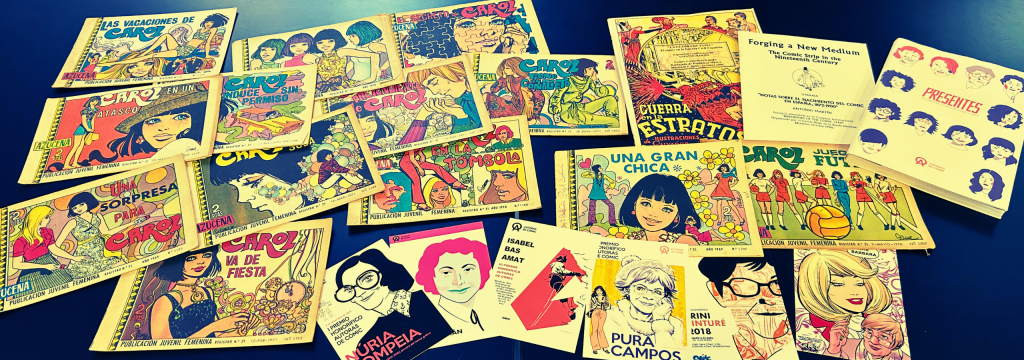
During the session, the following works were mentioned:
- 1925-1926 – The Nuri. Lola Anglada
- 1934-1937 – Cannito and his cat Peladilla. Pitti Bartolozzi
- s.f. – Carol. Gemma Sales (drawing), Victoria Sau (screenplay)
- 1952-1967 – Ana Emilia and her family. Isabel Bas Amat
- 1971-? – Esther and her world (orig. Party’s World). Pure Fields
- 2014 – TBO editions, tell me: Secret memoirs of a secretary. Rosa Segura
- 2016 – Present: Authors of comics of yesterday and today. Comic Book Authors Collective / AECID
> Collaborate


> Finance
Other Work





 English (UK)