
CYCLE II | The (r)evolution of comic book authors [2/4]

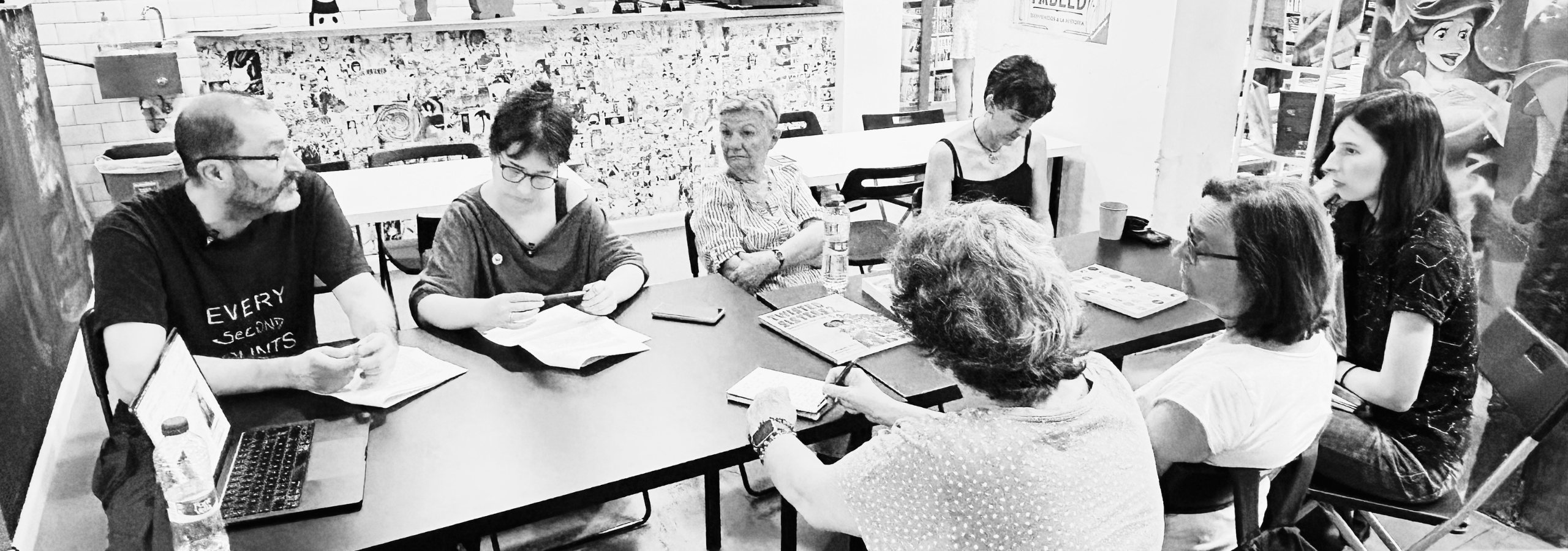


Last Wednesday, May 27th, we continued with the project “Visitising comic book illustrators and artists on Wikipedia”, coordinated by Wikisphere and funded by the Women's Institute. The second session of the CYCLE II | The (r)evolution of comic book authors: From Classicism to Modernity, driven by Elisa McCausland y Diego Salgado, traced the history of illustrators and editors in American comics, from the Silver Age to the heiresses of the underground feminist.
> Listen to the session
We will record all the dissemination sessions of this project that we will organize in several bookstores in Madrid.
Also, you can follow our IVOOX Channel so you don't miss any.
> Summary
Elisa McCausland and Diego Salgado analyzed in this second session of the second cycle of disclosure what the 50s were like in the United States, in an America full of contradictions: The Second World War had massively incorporated women into the labour market, but the post-war period brought strong pressure for them to return to the domestic sphere. It was precisely this tension that Betty Friedan diagnosed in The mystique of femininity, unveiling the profound dissatisfaction of thousands of women trapped in a model of life that was presented to them as the only possible. What was expected of them and what they had already shown they could do permeates both the cinema of the time and their graphic humor, and explains why the change was gradual and cumulative, not a sudden outburst.
The the Silver Age comic book introduced more complex superheroes and superheroines and, with them, an increasingly notable female presence in the industry. Educated and university women entered as authors and editors, gradually transforming the medium from within. Holly Resnikoff wrote romantic stories with feminist nuance from Marvel; Flo Steinberg it ranged from letters from readers to becoming a screenwriter; Dorothy Woolfolk edited important headlines after years away from the sector. Marie Severin He worked in all aspects of the trade (color, tinting, character design, merchandising) with an overall vision that few had. Y Jennette Kahn, with actual executive power in DC Comics, left a structural imprint: When she left, half the staff were women.
The Jump to comic underground It wasn't just cultural: It was also economical and technical. The self-censorship code that regulated the sector worked because distribution was centralized. When independent bookstores and the xerography greatly reduced production, the system cracked. A new, freer and also more precarious ecosystem was born, where the Wimmen’s Comix (in English), powered by Trina Robbins in the 1970s with an intense internal debate about what that space should be: the representation of love between women, lesbian authors, political correctness, the balance between dissemination and personal expression. More radical in his proposal was Twisted Sisters, one anthology that prioritized one's own experience over any editorial program. His heiresses (Phoebe Gloeckner, Debbie Drechsler (in English), Aline Kominsky, Diane Noomin) formed a current in which activism and autobiography became central narrative tools. Not without risks: These publications constantly faced the threat of being classified as pornography and suffering censorship or persecution.
Transit of underground to independent comic book It involved a paradox. The underground was necessarily marginal: could not be sold in conventional kiosks. The independent created a parallel circuit of specialized bookstores with direct sales, which offered greater thematic freedom but was also part of the commercial system. Over time, that independent space was absorbed by the mainstream. Wendy Pini illustrates this tension well: created ElfQuest with his partner from the most artisanal self-publishing, but with a vocation of Heroic fantasy that ended up finding channels mainstream. For its part, Karen Berger He revamped the 1980s comic book by traveling to Britain and discovering a new generation of authors who brought a distinct literary sensibility. That experiment crystallized in the early 90s on the seal Vertigo, the attempt by major publishers to absorb the adult market without losing their commercial identity.
The tour went as far as Alison Bechdel, author of Fun Home y Are You My Mother, whose trajectory summarizes many of the tensions of the period: the conversion of the underground to the graphic novel, the discomfort of that transit, self-determination as a process never completely resolved. Bechdel has publicly questioned his own transition, and his current work remains anchored in the exploration of the everyday and the intimate.
> Bibliography
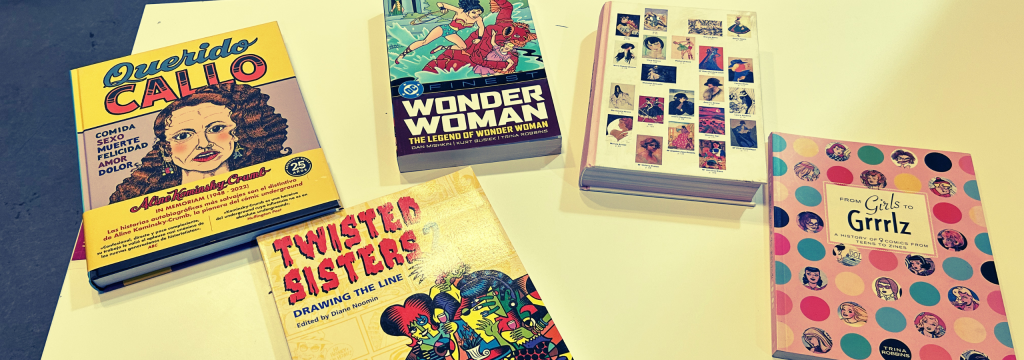
During the session, the following works were mentioned:
- 1963 – The mystique of femininity from Betty Friedan
- 1970 – It Ain’t Me, Babe from Trina Robbins y Barbara "Willy" Mendes, the first comic book produced entirely by women
- 1972-1987 – Tits & Clits Comix from Joyce Farmer y Lyn Chevli
- 1973 – Abortion Eve by Joyce Farmer and Lyn Chevli, an educational comic about women's newly guaranteed reproductive rights
- 1976 – Dynamite Damsels from Roberta Gregory
- 1998 – Bitchy Bitch Roberta Gregory 's
> Collaborate


> Finance

Other Work


![CYCLE I | Pioneers of illustration and comics [3/4]](https://www.wikiesfera.org/wp-content/uploads/2026/02/cabecera-wikiesfera_morado-400x340.png)

 English (UK)