
Dear wikijabatas,
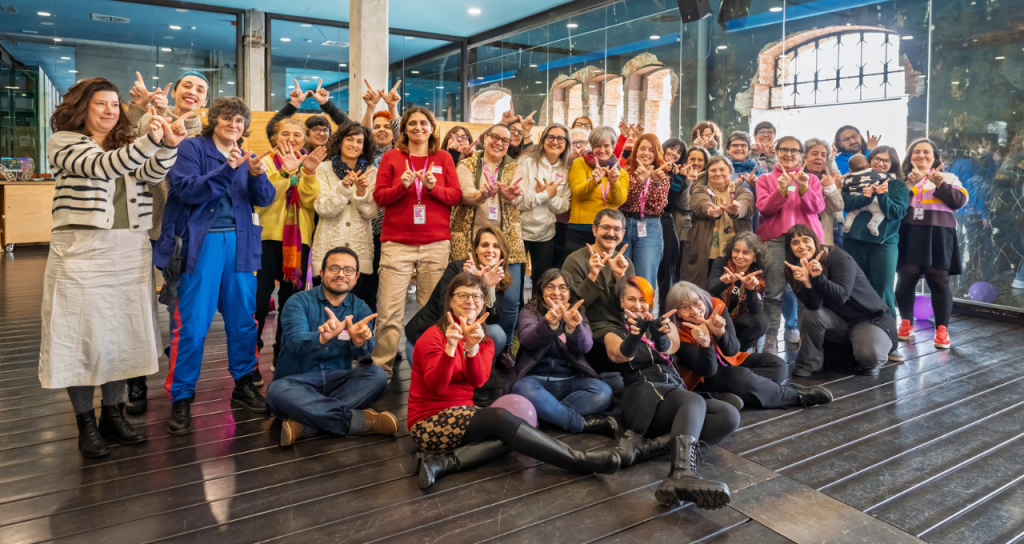
I write this text from another place, one that I had not allowed for too long. I'm writing to you from the self. The one right now. That 48-year-old looks at her other self, the 38-year-old, and is fascinated and proud of what happened in this incredible decade. I hope you allow me to expand because ten years give for a lot and what began with a doubt of somewhat naive activist has ended up becoming a central project in my life. We are a feminist community created from affection and perseverance (a quality that I didn't think I had in me), around a technological tool of knowledge that has collaborative development in its DNA. This is the story of Wikisphere told without links, bold or metrics but with the heart in hand. Because if I have learned anything in this decade it is that knowledge is also built from memory, emotions, conflict and rebellion. In the face of an unfair system, it is wonderful to be able to face adversity together with colleagues who share the same values and principles. Companions like you. Thanks for being there.
An uncomfortable question
In 2014 I had not designed a master plan. But there was a topic that had been around me for a long time and that had me baffled. It came from the experience of the 15Mpedia, a wiki that we created among several activists after the 15M to document a historical social movement, and that had not worked as I expected. The tool was there, open, available... but people didn't edit and I didn't understand why. That same year I went to work as a cultural mediator and researcher at Medialab Prado, in Madrid, and decided to find out the reasons why that commitment to document assemblies and claims actions in a decentralized and collaborative way had not settled, and I incorporated it into my line of research.
I organized open sessions to understand why people edited or didn't edit a wiki much more famous than my little-wiki-activist: Wikipedia. And as a good Wikipedian, I documented everything. In those meetings, in which I corroborated that technically the wiki world was much more complicated for most mortals, an issue arose that I did not count on and that completely affected my own approach to the group. While I defended the importance of participating by creating content in the most consulted online encyclopedia of the moment, one woman told me: ‘But Patricia, who am I to write history?’.
Oh, boom! There I understood that the problem was not (only) technical. He was a politician. Symbolic. Emotional. It was not a question of knowing how to hit a button, but of feeling entitled to occupy a space that we have been told, in a thousand ways, that it is not for us. Especially women. Wikipedia, despite its opening speech, is a tough place: little pedagogical, full of implicit norms, conflicts, informal hierarchies and various egos. And the data that had just been published on participation was bleak: only one in ten people who edited Wikipedia was a woman and less than 20% The biographies were of women. I understood that if I wanted more editors, it wasn't enough to show how the tool works. It was necessary to create a space where making mistakes would not entail punishment and one would not have to ask for permission or forgiveness at every step. We needed a place where the demand and the self were left out, and we could put curiosity, exchange ... and sweets at the center! We had to build a place to become Wikipedians.
Learning together
From that moment, Wikisphere began to take shape as something very concrete: a horizontal learning space. I did not have all the answers (and I still do not have them), but I was clear that I did not want to reproduce hierarchies or unquestionable authority figures. My role was always to accompany. Accompany in doubts, errors, blockages, discoveries. Edit together, think together, laugh when something “broke” (remembering with great emphasis that the wonder of the digital world is that there is the CTRL+Z to undo the failures) and celebrate each small advance. That same year and seeing the experience of the first months I made another important decision: When I finished my mediating stint at Medialab, I didn't want Wikisphere to evaporate. From September 2015, every Monday afternoon I would be editing in a room that anyone could come to, without having to sign up or notify. While I was throwing it I thought that probably many times no one would come but I didn't worry: I wanted Wikisphere to be a place of reference to approach out of desire and need. And, as a curious fact, I was never alone.
In 2015, I also organized the first edition of Wikiesfera. I remember her very fondly. I had never done anything like this before, but I was clear about what I wasn't looking for: an article production activity. I wanted something else. That that room with tables, chairs, strips and a projector was a space for reception, dialogue and learning, and that no participant felt alone before the screen. And, in fact, it was a starting point for what ended up being our editatonas: Successful experiences in publishing on Wikipedia. It was not necessary to know anything to participate because we were going to work together in the creation of biographies of women, using the Internet, shared documents, discovering all the keys so that these articles were built in depth and form with the criteria of the Wikipedian community, and we would publish them together at the end of the day with a collective high. The applause and excitement when yelling “The first article is ... PUBLISHED!” They put us all in orbit.
Without intending it, and with the contributions of the people who supported Wikisphere and believed in its potential from the first moment, I developed a system that has worked in an incredible way. I added to my own recipe the ingredients that I understood fit perfectly to multiply the success of the activity: choose a topic that aroused interest, get an expert to give us the context, accompany the working hours with something to take to our mouths, and whenever possible, give a book related to the participants, thanking and recognizing their contribution. We have been applying improvements to that formula. But we've essentially used it to critical and public success... in more than 180 editatonas! Don't you think it's amazing? It still gives me vertigo, really.
The Third Time
Face-to-face was key in the early years. We came from a time very marked by digital activism, and I felt that we needed to meet to do things in person. And I guess partly because of that and partly because we had a great time when we got together on Mondays, the meetings didn't end when we closed the laptops. Many times they were still outside, having a drink in a bar near Medialab. That informal time (our beloved “third time”) was as important as editing. There friendships and complicities were forged, difficult moments were sustained and something was built that goes far beyond Wikipedia: our community.
In that first year I met María Sefidari, then president of the Wikimedia Foundation and now my reference in the world in terms of strategy, as well as a great friend and wiki partner. Our first meeting can be said to be... abrupt (although now we remember it with laughter). I had my reservations about his commitment to combating the gender gap on Wikipedia, completely unfounded, I recognize. But they dissipated when I saw her working side by side at one of the Wikisphere meetings. For a while we linked Wikiesfera to WikiMujeres, the group she had created with journalist Montserrat Boix. We shared goals, but differences also appeared: rhythms, care, sustainability, limits of volunteering. So, after the 2017 WikiWomen Camp in Mexico, Maria and I made an important decision: Wikisphere had to be independent.
Growing up in a group
This change allowed us to widen our eyes. We did not want to talk only about the gender gap, but also about other knowledge gaps that touched me particularly, such as Historical Memory in Spain. And a few months later, we gained recognition as an official Wikimedia Movement group, which gave us legitimacy. The group grew slowly, with no obsession with productivity. Some people came and went, others stayed and joined the fledgling community. Actually, there was no pressure from anyone: We met because we had a good time together, and the constancy of those meetings came naturally.
In 2017 many beautiful and powerful things happened. I remember with special affection the nightly editatonas in which we started at 9 pm and I ended up getting into bed at 2 am, exhausted but happy. Of those there was one about witches that we celebrated on Halloween. Yes, yes. We were even disguised and read a spell! What a time... There were also editatonas in some municipal libraries about the women of the streets of Madrid (another exciting project). And I gave a TEDx talk that marked a before and after: No one will talk about us if we're not on Wikipedia. Putting words to what we were already doing helped more people understand that this was about politics and feminism, not just encyclopedias and free knowledge.
Go outside and look in the mirror
That same year, a team from Deutsche Welle Akademie contacted me. They wanted to make visible on Wikipedia the worldview of the indigenous peoples and nationalities of Ecuador. There's nothing! This is how it was born We took the Wiki that saw the light in 2018. It was a wonderful project that I took with great desire because I saw it as an opportunity to test my horizontal learning method in a different context. Now it gives me some modesty to remember how I approached it, thinking that I understood the linguistic and cultural circumstances that I was going to encounter, and believing that I did not have a colonialist look... Oh, friends. They had to spend several months of activities with a fantastic team to discover with real astonishment that the mother tongue of those who participated in the workshops was not Spanish (however incredibly well they spoke it) but Quechua. So when I told them phrases like “Use your own words” o “Write directly and clearly, in plain language” (which had worked so well for me in Spain) I was messing up by ignoring their language and expressions. It was one of the participants who mentioned it to me with great affection. And I wanted him to swallow my earth. How could she have been so foolish? I felt ashamed of myself, I confess. That made me reflect a lot on the importance of how to occupy certain spaces even if we have been invited. I discovered my own biases. And also that it can be accompanied from other non-central places.
It is true that after that experience I doubted very much. I doubted me and the method. I doubted the horizontality I had presumed. I doubted my way of explaining and bringing more people to Wikipedia. But amid the doubts, Tila Cappelletto appeared to regain my confidence in what I had been doing before Ecuador. She, another of my pillars since then, had participated in the first editatona in 2015 and came to see me at one of my Monday meetings after several years. He told me how enthusiastic he had been about the approach of that experience and the group itself, and that he wanted to replicate it... in Portugal! I had spoken to a group of activists in Lisbon and they wanted to invite me to coordinate the activity. She told me that it wasn't a problem that I didn't speak Portuguese (something I would like to change), and that they were very excited that I was going. My dear Tila made possible the meeting in March 2019 that ended up becoming the seed of a new group of users called WikieditorasLX, led by incredible women. I feel like the first sister node to Wikisphere. And there can be nothing more beautiful. Because it also served to demonstrate (and prove to me) that this system, shared from the right place, could be replicated.
In parallel to the trips and experiments, I kept organizing editatonas wherever I could. And this was how in that 2019 I met and was met by two incredible companions who today occupy a central place in Wikisphere: Isabel Zapico and Liliana Alviárez. Isa participated in an editatona of STEM women that was organized within the Festival Princesas y Darthvaders in La Casa Encendida, and Lili in a circus editatona that we organized in the Teatro Circo Price thanks to María Folguera its director at that time, worried about recovering the circus memory. They got hooked on the world of publishing and I can't be more grateful for their love for this project. I tell you that without them, without their support, their work and their complicity, we would not have reached this decade of celebration.
When everything wobbles
The arrival of the pandemic and the lockdown in March 2020 forced me to do something I had always avoided: move on to meeting virtually. But it was necessary if he didn't want Wikisphere to disappear. I recognize that it was a surprise to see the reaction of those who already felt very much within the project. I opened a Zoom account and we started to test what it was like to see ourselves on screen. And it worked. He did so well that we decided in one of those new virtual meetings on Mondays to organize an editatona also virtual! I was very worried about how to help the new editors without being with them in person, but we ended up designing a new system maintaining at all times the premise of the accompaniment. I learned to create rooms with small groups, in which there was always some experienced editor, and I was entering each one to see how they were going and solve doubts. The success of some of those editatonas made me see the importance of offering a virtual space both for people who did not live in Madrid and for those people who, by schedule or location, could not come in person neither to the weekly meetings nor to the editatonas. And that's why, today, we hold virtual meetings every month.
In this context of pandemic, at the end of 2020 I organized a virtual edition together with the innovation laboratory of the Government of Aragon in which almost twenty women participated. And the Wikipedia editing virus (not the other one) spread strongly to two of them: Chon Benito and Ana Asensio. His enthusiasm and the support of the Aspasia Community of the LAAAB, as an essential institution, gave rise to the birth of WikiAragón. First Wikisphere node in Spain and paradigmatic example of how remote accompaniment can generate autonomy.
But the pandemic that impacted us in so many ways had a final blow from the institutional level with the closure of Medialab Prado in mid-2021. What had been my second home and the birthplace of Wikiesfera disappeared as a cultural project and, despite the promises of the Madrid City Council, we were orphaned to meet. Yeah, the program moved to Slaughterhouse. But that central space in which we crossed paths with other groups and where anyone who passed by browsing could get to know us, had died. We tried to resume the weekly meetings in the “new” Medialab, but they could not be on Mondays because it was closed and the alternative of meeting on Wednesdays could only be done every two weeks. The organization of editatonas was also paused, which could no longer be on Saturdays and that, later, we had to do them on Friday afternoon. A community, strong as it is, needs its routines and its recognizable places, and with so many changes they had completely dislocated us.
Despite the difficulties, we do not give up. And, in fact, as a somewhat more solid group that we formed between María Sefidari, Isabel Zapico, Liliana Alviárez and I, we decided to throw ourselves in the pool and ask for a grant to the Wikimedia Foundation for the first time at the end of 2021. We wanted to launch a project on Historical Memory of Spain to be able to map everything that was missing from Wikipedia and develop activities that would allow us to complete it. We were ambitious and had the worst possible accompaniment for a first time in this type of process: a person who did not know how to guide us correctly. We thought we had taken all the necessary steps and strived to submit the application in a timely manner for assessment. We gave it our all. And the slap was spectacular. I remember being stunned by the responses to the proposal from other Wikipedians: that why we had to do a project of this type with a gender perspective, that something like this could be done by a bot, that we wanted to charge as engineers ... We did not give credit. It was painful to realize the contempt that most of those people expressed in writing. And frustrating to know that we were with them in the same boat: building Wikipedia. Even so, we responded to every comment with the education that they had not had with us (and that no one from the foundation was in charge of stopping). So much code of conduct, so much respect for the label... all wet paper.
Needless to say, I almost threw in the towel. It was too much at a fragile time. I thought that if everything was really against us, there was no point in moving forward. Still, we held the group as we could for almost a year. And it was a trip to Ireland where I participated with other Wikipedians around the world that reminded me that we were part of something much bigger. That our struggle went beyond ourselves. And I came back willing to stand up to that uncertain future.
Reinventing Yourself to Stay Alive
In 2022, my friend Alina Zarekaite decided to open her bookstore La Fabulosa in the center of Madrid with spaces to organize activities. And, excuse me for the easy resource, but it was like a ray of light among so many darknesses. At the end of that year was also the time when we first got the financial support to move forward. And despite my reservations about what any infrastructure entails that involves bureaucracy, we created a partnership with which we began to work on internal governance, care, sustainability. A tool to keep moving forward with our mission.
And so, between books, requests for financial aid and official documents, Wikisphere entered a new stage with more institutional projects, more cultural alliances, more visibility ... but without losing its essence. Also incorporating the team to Encina Villanueva, who came to reinforce the part of relationship with museums and libraries, our GLAM side. A fifth leg that had been in the group for many years and shared the importance of our work. Since then, it gives us a complementary and fundamental vision: from art, feminist listening and caring for all.
These last years of changes have not been easy but something wonderful has happened and that, those of you who are in the day to day, you know very well: I am no longer alone at the forefront of this project that I am passionate about but was consuming me. I felt the responsibility to fight even if I didn't have the strength to continue, convinced that what we are doing is important. But battles, despite what fiction makes us believe, are not won by a person. We don't need figures to bleed but to change the way we face the struggle. And do it together. Isn't that right, Maria, Isa, Lili, Oak?
We're finally a team, friends.
A final reflection
Wikisphere has surpassed any expectations I might have when I organized that first meeting to analyze why there were so few people editing Wikipedia. It has helped me to better understand the power structures that, from feminisms, we try to transform: Who writes history, who validates what is considered relevant, who occupies the spaces of knowledge.
Over these ten years, I have learned that it is not enough to point out the gap: we must weave nets that allow us to close it together. I have enjoyed teaching what I myself was learning and I have suffered seeing how other companions were silenced or expelled from spaces that should be opened. But I've also witnessed how many women get excited about publishing their first article and all around us applaud that individual and collective achievement. They have felt the value and importance of publishing about other women who had not been visible until then. And they discover that they can build Wikipedia with their own voice. This remains one of the most powerful political acts I know of.
Occupying a digital space like Wikipedia from the feminist commitment is a revolutionary act. Wikiesfera was born as a tool to solve difficulties and break fears in the face of a hostile place, but it has become a living community, which grows, multiplies and transforms.
Because #JuntosSomosMásVisibles is not just a motto: It's a way of being in the world. And these ten years, dear wikis, are just the beginning.
Acknowledgments
To all those who have edited, accompanied, doubted, celebrated and sustained Wikisphere in these ten years: Thank you. This text cannot name you all, but it is written with you.

 English (UK)