
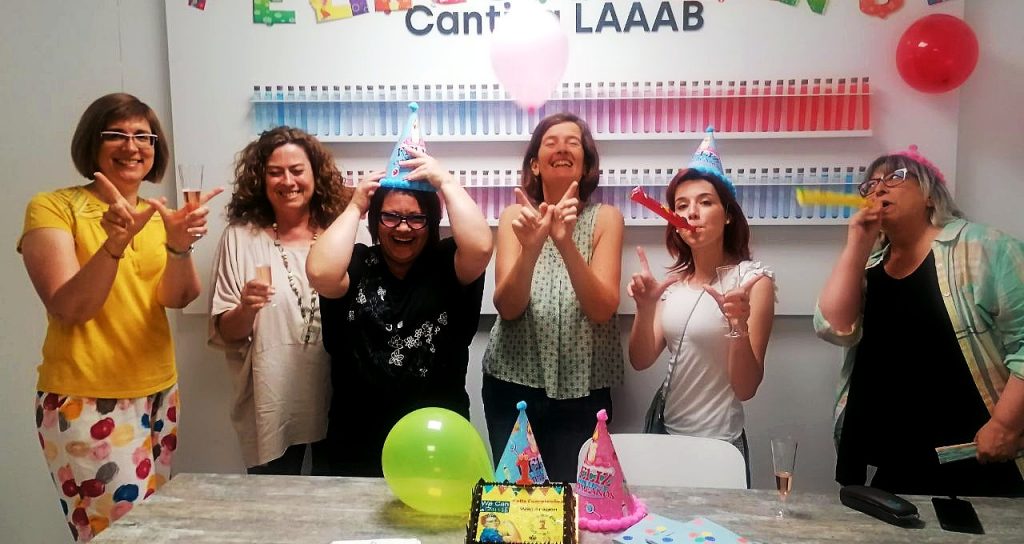
A year ago we told you that a Wikiesfera working node in Aragon: #WikiAragon (@WikiAragon) in the Laboratory of Aragon [Government] Open (LAAAB), an independent group born from the #the Aspasia Community with the idea of giving greater visibility to women on Wikipedia, creating biographies of relevant Aragonese women. And they've already celebrated their first birthday!
> Celebration text
6 June 2022: celebration of the first year of Wiki Aragón, as we met for the first time at the beginning of June 2021, on Thursday 3rd for more signs. Established on the first Monday of each month as a guideline to meet again, here we are celebrating our first return to the sun.
As June 6th, who could we entrust or dedicate this event to or simply have in our special memory today?

Recalling the phrase “because they were, we will be; because we are, they will be”, let's see the events that Wikipedia points out for today. In births, the first woman who points us, in 1772, is Maria Theresa of the Two Sicilies, referred to as “Italian aristocrat, wife of Emperor Francis I of Austria”; wife of ... we did not start very well ... Such a day as today of 1872 was also born Alexandra Fyodorovna, “Russian aristocrat, wife of the Tsar”; again wife of ... And among a majority of male names, we have to jump into the twentieth century to find the first women born on June 6 who are not referenced in relation to anyone else, case in 1901 of Jan Struther, British writer, creator of the character of Mrs. Miniver and in 1904 Lesley Blanch, British writer and adventurer.
For those of us who love cinema, we would highlight the birth on a date like today in 1950, of the Belgian filmmaker Chantal Akerman, one of whose axes of its filmography was the representation of female identity, counting among its most emblematic titles with Jeanne Dielman, 23 quai du Commerce, 1080 Bruxelles (1975), praised by the New York Times as ‘the first masterpiece of feminism in the history of cinema’.
Let's now go back to the seed of WikiAragón, moving to the presentation, in November 2020, in this same space of the LAAAB, of the Aspasia Community, which had two magnificent inaugural talks by our mentor, Patri Horrillo, and of the writer Irene Vallejo.
Irene Vallejo, as you know, is the author of the award-winning essay Infinity in a reed: the invention of books in the ancient world. In this magnificent book, among many other illustrious names, he relates to Hypatia y Aspasia, women of antiquity who in their time occupied a relevant place in the public sphere and who were then unjustly forgotten and ignored in history, until relatively recent dates when they have been recognized and investigated as they deserved.
Among the most contemporary female figures to us that also includes Irene Vallejo in her essay figure Marguerite Duras, citing in particular his book Write, which is another essay, this time of an introspective biographical nature.
Let us dwell on an excerpt from this book of Duras, which reads as follows:
‘Around the person who writes books there must always be a separation from others. It's a loneliness. It is the loneliness of the author, that of writing. To begin with, one wonders what is that silence that surrounds him. And practically at every step that takes place in a house and at all hours of the day, under all the lights, whether from the outside or from the lamps lit during the day, this real solitude of the body becomes the, inviolable, of writing.
And how does all this connect with today's celebration?
In that all the women mentioned are our predecessors, reference women in each of the fields in which they excelled.
And that referent being would not have been possible if one person first, and many others later, highlighted their achievements and recorded them in some way for later; usually in the press, books, encyclopedias... or later also in cinema and other more modern media.
Here is the outstanding role of Wikiesfera: with Patri Horrillo in charge and with the whole team that, since its creation in 2015, has been adding. With an exemplary work in the expansion in Wikipedia of biographies of women and in their work always from the gender perspective. A work that inspires and encourages us. Therefore, our special thanks, from Wiki Aragón, to all its members, as our reference women in this work that, for a year, we undertook. Our thanks also go to the Aspasia Community and LAAAB for their unconditional support.
Walker there is no way, he makes his way when he walks, wrote the poet. And here we are, walking, and best of all, on a path that is not solitary, as Marguerite Duras wrote, but is a joint and communal path, in company, which makes it much more joyful.
So, for that company in which the energies do not add up, but multiply:
Thank you all, comrades!

> Do you want to participate?
If you want to be part of #WikisphereAragon and learn about the world of editing on Wikipedia, you can get in touch with them writing to wikiesfera.aragon@gmail.com.
- 📅 DATES: 1st MONDAY of the month (if it is a holiday, the next)
- ⏰ SCHEDULE: 17:00h. – 7 p.m.
- 📍 PLACE: Laboratorio de Aragón [Government] Abierto (LAAAB) | Plaza del Pilar 3 | 50003 Zaragoza
Or by contacting them at your Social Networks:
- ⁇ Instagram: https://www.instagram.com/wikiaragon/
- ⁇ Twitter: https://twitter.com/WikiAragon
- ⁇ LinkedIn Group: https://www.linkedin.com/in/wiki-aragon/
- 🌍 Website: https://wikiaragon.wordpress.com/

 English (UK)